
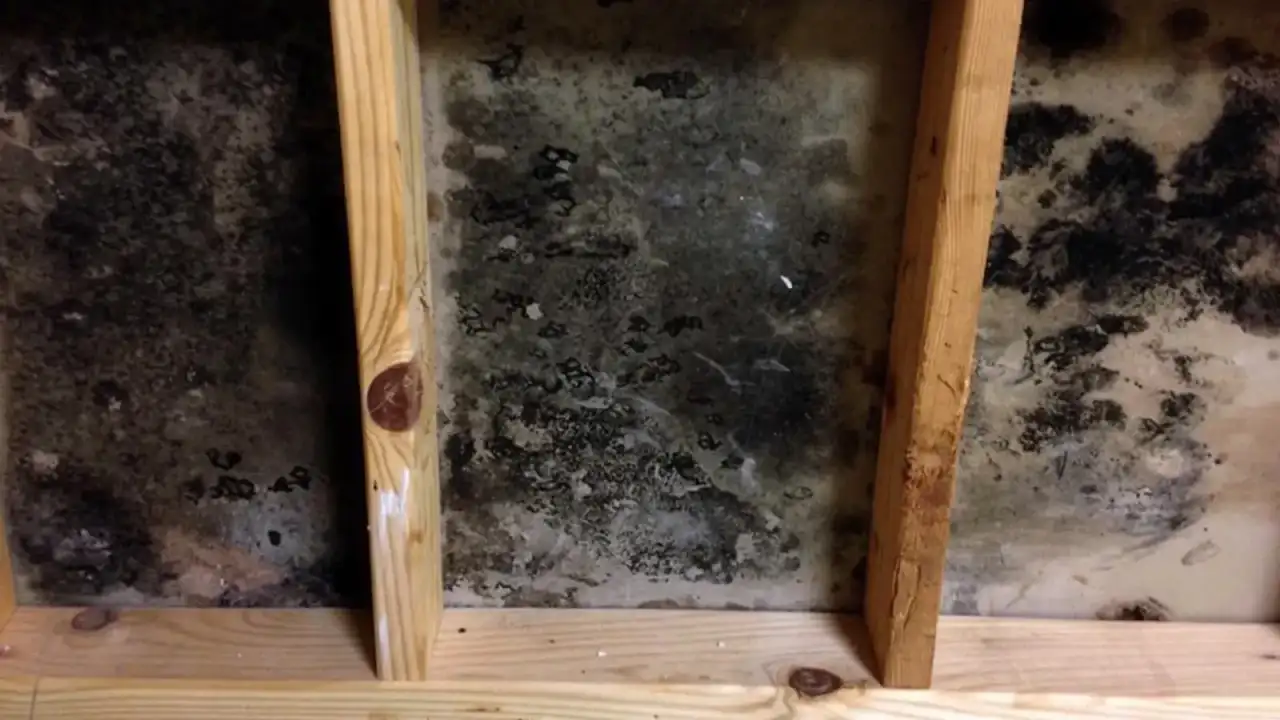
Signs you need this
- • Dark spotting or fuzzy black, green, or gray patches spreading across a basement wall, closet corner, or the drywall behind a bathroom vanity
- • A musty, earthy smell in a finished basement or a three-decker unit that never fully airs out, especially after a wet spring or a stretch of humid Worcester summer weather
- • Drywall that feels soft, bows outward, or crumbles at the base near the floor plate, usually where a foundation wall in Vernon Hill or Main South has been holding groundwater against it for weeks
- • Paint or wallpaper bubbling and peeling near a stained joint, tracing back to a slow leak the homeowner only noticed once the wall started smelling off
Mold on wet drywall shows up fast, so this comes up most for homeowners in Vernon Hill, Grafton Hill, and Green Island whose pre-1940 basement walls show mold after a spring thaw or a sump pump failure, for landlords and property managers running Worcester three-deckers in Main South and Green Island who need a unit turned around between tenants or a health complaint resolved on a tight timeline, for suburban owners in Holden, Shrewsbury, and Grafton who finished a basement and found mold behind the drywall after a slow, unnoticed leak or a humid crawlspace connection, for homeowners selling or refinancing who need mold-affected drywall documented and replaced to satisfy an inspection contingency, and for anyone who already dried out a wall after a burst pipe or ice-dam leak and is now seeing staining or spotting develop on the drywall paper weeks later.
Mold on drywall paper spreads within days once conditions are right, and every week of delay adds cut-back area, drives the smell deeper into the cavity, and raises the odds that a specialist remediation scope becomes necessary instead of a straightforward replacement. Worcester’s damp basement stock, especially near the Blackstone headwaters, means the moisture source rarely resolves on its own, which is why Worcester Drywall & Plaster treats a mold call as urgent.
Worcester Drywall & Plaster removes drywall that has visible mold growth or moisture damage on the paper facing, cuts back to sound, dry material, and rebuilds the wall with mold-resistant board sized to the space. This is a replacement scope: cutting out affected gypsum, verifying the framing cavity is dry, and closing the wall with a board built to resist future moisture, not a remediation scope covering airborne spore cleanup across a structure. Worcester Drywall & Plaster works within a defined boundary and hands off larger or HVAC-spread mold situations to a licensed remediation specialist first, then returns to rebuild once that work is cleared.
Why Wet Drywall Grows Mold So Fast
Drywall paper is paper, and paper is food for mold. The gypsum core itself doesn’t feed mold growth, but the cellulose facing on both sides of a standard sheet is exactly the organic material mold spores need once conditions line up: moisture, a food source, and time. In a Worcester basement with damp block walls near the Blackstone headwaters, or in a bathroom-adjacent wall in a Green Island three-decker with poor ventilation, that combination can show up fast. Under the right conditions, mold can establish itself on wet drywall paper within 24 to 48 hours. That’s why Worcester Drywall & Plaster treats any report of a damp, musty-smelling wall as time-sensitive rather than something to schedule around.
The speed matters for another reason. The longer wet drywall sits, the more likely the mold works its way past the surface paper and into the gypsum core and the framing behind it, turning a wipe-and-patch situation into a cut-and-replace one, and eventually into something bigger than drywall replacement covers at all.
The Line Between Remediation and Replacement
Worcester Drywall & Plaster draws a clear boundary on this. Mold remediation, the kind that involves setting up sealed containment, running negative air machines, and doing airborne spore testing across a structure, is licensed specialist work governed by guidance like IICRC S520. That’s not what Worcester Drywall & Plaster performs.
What Worcester Drywall & Plaster does is drywall replacement: identifying mold-affected board, cutting it back to sound material well beyond the visible staining, and rebuilding the wall correctly. For a small, contained area, that’s a self-sufficient scope with basic dust control. For mold that’s spread across multiple rooms, traveled through HVAC ductwork, or covers a large share of a finished basement, the right move is to pause and bring in a remediation specialist first. Worcester Drywall & Plaster will say so directly rather than take on a scope that’s outside a drywall contractor’s lane, and will return to do the rebuild once that containment work is cleared. Homeowners in Holden and Shrewsbury finishing basements, and property managers running three-deckers in Main South, get the same honest read either way.
Source-Fix-First, Always
Replacing drywall over a moisture problem that hasn’t been resolved is a wasted job. If a basement wall is wet because of a foundation crack, poor grading, or a failing sump pump, new drywall over that cavity will show the same staining within a season. Worcester Drywall & Plaster identifies the likely source during the initial assessment, whether it traces back to an ice-dam leak from a Worcester winter, a slow plumbing drip behind a bathroom wall, or groundwater pressure against an older foundation, and flags it before any board goes back up. Sometimes that’s a separate trade’s fix, a plumber or a foundation contractor. Sometimes it’s straightforward enough that the homeowner just needs to know to address it before or alongside the drywall work.
Choosing the Right Board for Damp Worcester Conditions
Not every wall needs the same board. A dry, above-grade interior wall gets standard drywall. A basement wall, a bathroom-adjacent wall, or any space with a documented history of dampness gets a moisture and mold-resistant option instead. Worcester Drywall & Plaster works with several depending on the application: purple board (M2Tech) as a common moisture-resistant choice, DensArmor Plus or DensShield where a fiberglass-faced, paper-free board better resists mold growth in a persistently damp basement, and USG Mold Tough or Gold Bond XP as comparable alternatives. Where a wall assembly needs both moisture resistance and a waterproofing layer, such as behind a tiled shower surround, RedGard gets applied as a membrane rather than relying on the board alone. Where fire separation applies, such as between a basement and living space above, Type X board keeps the assembly code-compliant under 780 CMR.
Verifying Dryness Before Closing the Wall
Closing up a wall cavity that still reads wet is the single most common way this kind of job fails. Worcester Drywall & Plaster checks framing moisture content with a meter before installing new board, generally aiming for readings around 16 percent or lower, rather than estimating by feel or by how long it’s been since the leak. A cavity that tests dry gets new board right away. One that doesn’t gets more drying time, sometimes with a fan or dehumidifier running, before the wall gets closed. Skipping this step is how a homeowner ends up paying for the same repair twice.
Working in Occupied Three-Deckers
A large share of this work in Worcester happens in occupied buildings, not vacant renovation sites. A three-decker unit in Vernon Hill or Grafton Hill with a family or tenant still living there needs a different approach than a gutted basement: containment that keeps dust and spores out of the rest of the unit, work scheduled around the household’s routine, and daily cleanup so the space stays livable. Landlords and property managers coordinating this across multiple units, often on a deadline tied to a lease renewal or a tenant complaint, need a contractor who can move efficiently without disrupting the building more than necessary. Worcester Drywall & Plaster sets expectations with the homeowner or property manager up front: what containment will look like, how long the area will be closed off, and when it’ll be back to normal.
Related Work
Water damage drywall repair often comes first, when a leak or flood is the root cause and needs its own fix before mold-affected drywall comes out. A mold remediation specialist handles the affected area first when it’s large or has spread through HVAC. Afterward, painting and texture matching blend the new board into the existing wall finish, and basement finishing work often follows for homeowners rebuilding a space once mold-affected drywall is replaced. Moisture source repair, a sump pump, grading, or a plumbing fix, is commonly done in the same visit or scheduled immediately before the drywall work, so the new board doesn’t face the same conditions that caused the original problem.
Materials & standards
Products & materials we use
- Purple board (M2Tech)
- DensArmor Plus
- DensShield
- USG Mold Tough
- Gold Bond XP
- RedGard
Standards & codes we work to
- 780 CMR (Massachusetts building code)
- ASTM C1396
- GA-214 finish levels
- EPA RRP
- ICRA (infection control risk assessment)
- IICRC S520, referenced as the boundary marker for when remediation specialists, not drywall replacement, are the right call
- Massachusetts Construction Supervisor License (CSL)
- Massachusetts Home Improvement Contractor (HIC) registration
- EPA RRP Lead-Safe Certified Firm
- Massachusetts Department of Labor Standards asbestos requirements for pre-1940 housing stock
What the terms mean
- Containment and negative-air boundary (specialist scope, referenced but not performed by Worcester Drywall & Plaster)
- Cut-back to sound board
- Moisture content verification
- Source-fix-first
- Type X board where fire-rating applies
- Setting-type compound
Options & variants
| Option | When it applies | Cost |
|---|---|---|
| Localized cut-and-patch | Small, contained mold spot on a single wall section, source already fixed | Lower cost, smallest material and labor footprint |
| Full wall or room replacement | Mold has spread across a wall run, basement finish, or multiple stud bays | Higher cost, more board and finish work |
| Moisture-resistant board upgrade | Basement, bath-adjacent wall, or any space with a history of dampness | Modest upcharge over standard board, pays off by resisting recurrence |
| Post-remediation rebuild | A remediation specialist has already cleared the space and Worcester Drywall & Plaster is rebuilding after | Framed as a standalone rebuild once containment is lifted |
What affects cost
- • How much drywall has to be cut back: a single damp corner versus an entire basement wall run changes material and labor substantially
- • Access and finish level: an occupied three-decker unit with furniture and belongings in place takes longer than an unfinished basement
- • Board type selected: standard versus a mold- and moisture-resistant board like purple board or DensArmor Plus changes material cost per sheet
- • Whether the moisture source is already fixed. A wall that's still getting wet from an active leak or grade problem can't just be replaced, the source has to be addressed first, which is a separate scope
- • Texture and paint matching against existing wall finish, especially in an older Worcester three-decker with plaster-era wall texture nearby
- • Whether asbestos testing is needed first, relevant in pre-1940 stock where old joint compound or texture may require testing before demo
What to expect
- 1
Schedule an assessment
The homeowner calls or requests a quote, describes what they're seeing (color, smell, location, how long it's been there), and Worcester Drywall & Plaster schedules an on-site assessment, often same-week given the urgency.
- 2
Inspect and identify the source
On site, Worcester Drywall & Plaster inspects the affected drywall, checks the extent of spread, and identifies the likely moisture source, whether that's a foundation leak, a plumbing issue, or condensation.
- 3
Contain, cut back, or refer out
If the mold area is small and contained, Worcester Drywall & Plaster sets up basic containment, cuts back to sound board beyond the visible damage, and bags the removed material for disposal. If the area is large or appears to have spread through the HVAC system, Worcester Drywall & Plaster pauses and refers the homeowner to a licensed remediation specialist before any rebuild work starts.
- 4
Verify dry and rebuild
Once the cavity is confirmed dry, using a moisture meter rather than a guess, Worcester Drywall & Plaster installs new mold-resistant board sized to the space, tapes and finishes the joints, and matches the surrounding texture.
- 5
Walk through and document
Worcester Drywall & Plaster does a final walkthrough with the homeowner, confirms the finish matches, and documents the work for anyone who needs it for an inspection, insurance claim, or lease file.
When this isn’t the right call
- If mold has spread across multiple rooms, followed HVAC ductwork, or covers a large percentage of a finished basement, a better fit is a licensed mold remediation specialist first, before any drywall work begins.
- If the wall is still actively wet from an unresolved leak or grade issue, a better fit is water damage drywall repair paired with fixing the moisture source, since replacing drywall against an active leak just repeats the problem.
- If the issue is cosmetic staining with no actual mold growth or soft spots, a smaller patch and repaint may be all that's needed rather than a full replacement.
- If the property has known asbestos-containing materials in the wall assembly, testing and abatement need to happen before any cutting or removal, which changes the scope and sequence.
Frequently asked questions
Is this mold remediation or drywall replacement? +
Drywall replacement. Worcester Drywall & Plaster removes mold-affected drywall, cuts back to sound material, and rebuilds with mold-resistant board. Large-scale mold remediation, involving airborne spore containment and HVAC cleaning across a structure, is a licensed specialist's scope, and Worcester Drywall & Plaster will say so and refer out rather than take on work outside that boundary.
How do you know the mold won't just come back? +
Worcester Drywall & Plaster checks the framing cavity with a moisture meter before closing the wall, aiming for material dryness around 16 percent moisture content or lower, and won't install new board over a cavity that's still wet. Fixing the source of the moisture, not just the drywall, is what actually prevents recurrence.
Can you replace drywall while I'm still living in the unit? +
Yes. Most of this work happens in occupied Worcester three-deckers and single-family homes. Worcester Drywall & Plaster sets up basic containment around the work area, keeps dust and debris controlled, and coordinates timing with the household or tenant.
What kind of drywall do you use for basements and damp areas? +
Moisture and mold-resistant board, such as purple board, DensArmor Plus, DensShield, or USG Mold Tough, depending on the location and whether it's a wet-adjacent wall like a bathroom or a basement wall with a history of dampness.
How fast can this get done? An inspection or lease deadline is coming up. +
Worcester Drywall & Plaster prioritizes mold calls given how quickly it can spread and typically schedules an assessment within the week. Actual completion time depends on the extent of the area and whether the moisture source needs to be resolved first.
Do I need to test for asbestos before you start? +
In Worcester's older housing stock, homes built before 1940 may have joint compound or wall texture that requires testing before demo. Worcester Drywall & Plaster will flag this during the assessment if the property's age and construction suggest it's a concern.