
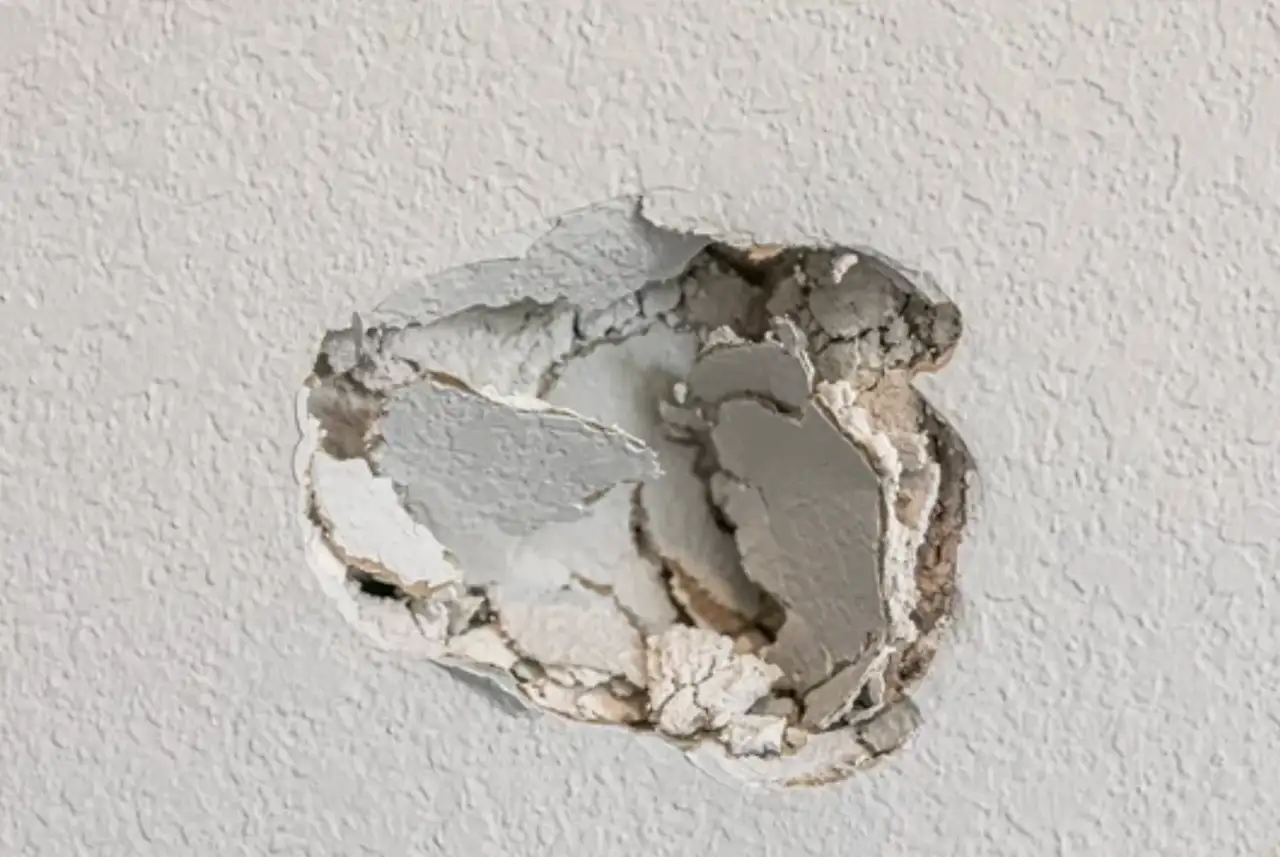
Signs you need this
- • A doorknob has punched a hole through the wall where it swings too far, or a hole was left behind by a moved piece of furniture
- • Dents, dings, and gouges from moving day, a delivery, or a kid's bike in the hallway
- • A cluster of small holes from a wall-mounted TV bracket, a shelf, or picture anchors that did not land where planned
- • Screws or nails that have popped slightly proud of the wall surface, leaving little raised bumps under the paint
- • Walls that need to be back to move-in condition before a lease ends or a home sale closes
Worcester Drywall & Plaster handles this kind of call fast on purpose. None of it is urgent in a safety sense, but a knob hole or a cluster of dents is usually tied to a deadline, a move-out inspection, a home sale, a security deposit, so the goal is a quick, affordable visit that gets scheduled promptly rather than pushed off.
This comes up most for tenants and landlords in Worcester’s three-decker rental stock managing turnover between tenants, where knob holes, anchor holes, and scuffed corners accumulate fast, for homeowners in Holden, Auburn, and Shrewsbury who just moved furniture, mounted a TV, or want years of accumulated dings fixed before repainting, for anyone preparing a room, apartment, or whole unit for sale or new tenants who needs the walls looking clean and unmarked, and for renters who need holes patched to get a security deposit back.
Worcester Drywall & Plaster handles the everyday wall damage that comes from simply living in and using a space: doorknob holes, dents from moving furniture, anchor and bracket holes, and popped fasteners. For small holes, that means a patch, a self-adhesive mesh patch or a cut-in piece of matching board, several thin coats of joint compound feathered wide enough to disappear, a light sand, and a texture match if the wall isn’t smooth. For a cluster of holes or a wall with years of accumulated dings, it can mean a broader skim coat across the section so the whole surface reads uniform rather than a patchwork of small repairs. This is fast, single-visit work aimed at the most common reason people search for a drywall repair: something put a hole or dent in the wall and it needs to look like it never happened.
The Most Common Repair in Any Worcester Home
Ask any Worcester homeowner, tenant, or landlord what’s wrong with a wall and the answer is rarely dramatic: a doorknob has swung too far and punched through, a couch got dragged around a corner, or a TV mount didn’t land where the studs were and left a small constellation of holes behind. This is the everyday wear that comes from living in and using a space, and it’s the single most common reason someone searches for drywall repair. It’s also, done correctly, one of the fastest repairs in the trade, which is exactly why doing it correctly matters: a rushed patch that ridges, flashes under paint, or doesn’t match the texture is more noticeable than the hole it replaced.
Reading the Damage Before Patching
Not every hole is the same repair. A doorknob hole is usually clean and isolated, an easy cut-in patch. A TV mount that missed the studs leaves several holes spread over a foot or two, better treated as one patch-and-skim across the whole section rather than four separate spot repairs, since trying to blend four isolated patches into a wall often looks worse than skimming the area as a unit. A dent or gouge from moving furniture can go either way depending on whether it broke the paper face of the board: a surface dent that didn’t tear through needs only compound, while a torn or crushed section needs an actual patch of new material.
Matching an Invisible Repair
The technical part of a small patch, mixing and applying joint compound, is genuinely simple. What separates a repair that disappears from one that catches the eye every time someone walks past is the feathering and the texture match. Compound has to taper out wide enough from the patch that there’s no ridge to catch light at an angle, which usually means a wider final coat than a first-timer expects. And Worcester’s housing stock carries several different wall finishes: smooth Level 5 walls in newer construction and additions, knockdown or orange-peel texture in a lot of mid-century and remodeled rooms, and the slightly irregular hand-applied texture of older plaster-adjacent drywall jobs. Worcester Drywall & Plaster matches the specific texture technique on the patched area, not just a generic spray pattern, and checks the result under angled light before calling it finished, since flat overhead light hides mismatches that a lamp or a window will reveal later.
Corner Bead and High-Traffic Damage
Outside corners take a disproportionate share of impact damage, moving day dings, a vacuum cleaner clipping the corner on the way past, a bike or stroller in a hallway. These corners are reinforced with corner bead, a metal or vinyl strip embedded in compound that gives the corner its crisp edge. When a corner is dented or the bead itself is bent, patching the compound alone doesn’t fix it, since the bead underneath is still deformed and will telegraph the dent back through no matter how many coats go over it. Worcester Drywall & Plaster replaces the damaged section of bead when that’s the actual cause, not just the compound covering it.
Why Rental Turnover Work Is Its Own Category
Worcester’s dense concentration of three-decker rental units, roughly six thousand across neighborhoods like Vernon Hill, Grafton Hill, and Green Island, means unit turnover patch work is a category unto itself. A landlord moving a tenant out often has a punch list of a dozen small holes and dents across one unit: anchor holes from a gallery wall, a doorknob hole in a bedroom, scuffed corners in the hallway. Worcester Drywall & Plaster treats this as one visit and one scope rather than pricing and scheduling each hole individually, which keeps turnaround fast between a lease ending and a new tenant moving in, a timeline landlords in this market care about as much as the quality of the patch itself.
Related Work
This is often the first call for wall damage, so nothing else usually needs to happen first. Once a patch is done, paint touch-up or a full repaint of the room finishes the job. A multi-unit turnover package is common for landlords patching several apartments at once, and crack repair often gets added on if a settling crack shows up alongside the holes.
Materials & standards
Products & materials we use
- USG Sheetrock
- Georgia-Pacific ToughRock
- National Gypsum Gold Bond
- FibaTape
Standards & codes we work to
- ASTM C1396
- GA-214 finish levels
- Massachusetts Home Improvement Contractor (HIC) registration
- Massachusetts Construction Supervisor License (CSL)
What the terms mean
- Joint compound
- Mud and tape
- Corner bead
- Mesh patch
- Cut-in patch
- Knockdown texture
- Orange-peel texture
- Three-decker
- Tenant turnover
Options & variants
| Option | When it applies | Cost |
|---|---|---|
| Small hole patch (under 6 inches) | Doorknob holes, anchor holes, single dents | Lowest cost, often same-visit |
| Multi-hole or clustered patch | TV mount holes, a wall with several small repairs needed at once | Mid-range, priced by count and spread |
| Larger cut-in patch (up to a few feet) | Furniture damage, a larger dent or gouge that took out the paper face | Higher cost, requires a cut-in piece and tape |
| Corner bead repair | Damaged or dented outside corners from moving or impact | Adds material and a specific finishing step |
What affects cost
- • Number and size of holes or dents, since a single knob hole and a wall full of anchor holes are very different jobs
- • Whether the wall is smooth or textured, since texture matching adds a step a smooth wall doesn't need
- • Whether paint touch-up or a full repaint of the wall is expected afterward
- • Access and how much furniture needs to move to reach the damage
- • Whether it's a one-and-done visit or a multi-unit turnover with several units to patch on the same trip
What to expect
- 1
Assess the damage
Worcester Drywall & Plaster looks at each hole or dent and confirms the fix is a patch, not a sign of something larger going on behind the wall.
- 2
Clean back to a solid edge
Loose or damaged material around the hole is cleaned back to a solid edge.
- 3
Set the patch
A patch is set, mesh tape or a cut-in piece sized to the hole, and the area is covered for dust.
- 4
Apply and feather compound
Joint compound goes on in thin coats, sanded smooth between coats, and feathered wide enough that there's no ridge.
- 5
Match texture and prime
Texture is matched if the wall isn't smooth, then the area is primed.
- 6
Final check and walkthrough
Worcester Drywall & Plaster does a final check by hand and eye before wrapping up, often in a single visit.
When this isn’t the right call
- If the wall shows a crack rather than a hole or dent, a better fit is drywall crack repair.
- If the damage is on the ceiling, a better fit is ceiling repair.
- If the hole or soft spot came from water, a better fit is water damage drywall repair.
- If the wall is original lath and plaster rather than drywall, a better fit is plaster repair and conversion.
Frequently asked questions
How much does it cost to patch a hole in the wall in Worcester? +
It depends mostly on the size and number of holes and whether the wall is textured, since Worcester Drywall & Plaster prices small single-visit patches differently than a wall with a cluster of anchor holes. See the homepage pricing table for a starting range and call for specifics on your situation.
Will you be able to match my wall's texture? +
In most cases, yes. Worcester Drywall & Plaster identifies whether the surrounding wall is smooth, knockdown, or orange-peel and replicates it on the patched area before painting, so the repair blends rather than standing out as a flat patch on a textured wall.
Can you patch several apartments in one visit for a rental turnover? +
Yes, this is common work for landlords and property managers with three-decker units between tenants. Worcester Drywall & Plaster can batch multiple units' patch work on the same trip.
My wall has a bunch of small holes from a gallery wall that didn't work out. Is that one repair or several? +
Usually one repair. Worcester Drywall & Plaster treats a cluster of small anchor holes as a single patch-and-skim job across that section rather than pricing each hole separately, which is often more efficient than it sounds.
Do I need to paint after the patch, or do you handle that? +
Worcester Drywall & Plaster's patch work includes priming the repaired area so it's ready for paint. Full wall or room repainting can be discussed separately depending on how much of the wall needs to match.
How long does a typical hole patch take? +
A small hole patch is often done in a single visit, since the compound only needs light drying time between thin coats. Larger or multiple patches may need a short return visit for final sanding and texture, but it's still fast compared to a full remodel.