
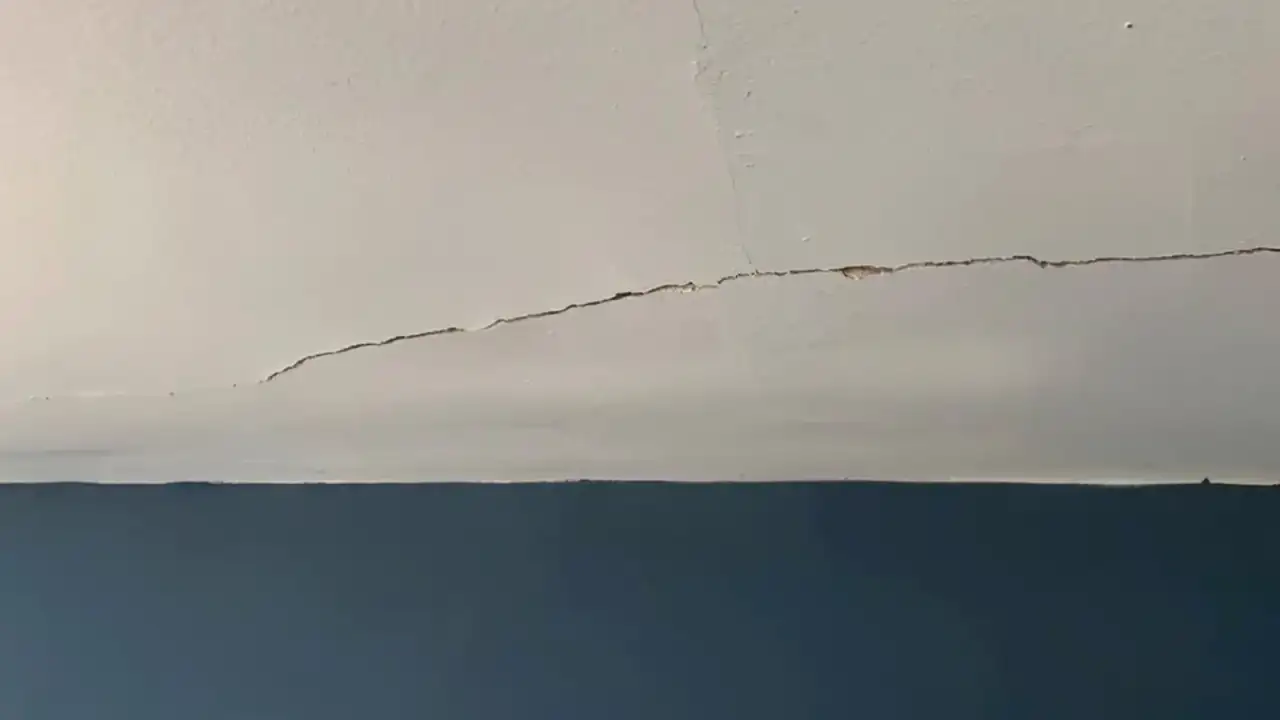
Signs you need this
- • A ceiling that bows or sags in the middle of the room, sometimes just an inch, sometimes enough to see the shadow line across the room
- • Hairline cracks branching out from a ceiling light fixture or a seam where two sheets meet
- • On older plaster ceilings, a soft or spongy feel underfoot upstairs matching a crack pattern below, or small chunks of plaster that have already dropped
- • A ceiling that moves slightly when someone walks in the room above it, or a faint crackling sound
- • A sag or crack that has grown noticeably over a few weeks, or that needs to be fixed before listing a home or unit for sale
Worcester Drywall & Plaster treats a sagging or cracked ceiling as a near-term repair rather than a someday job, even when nothing about it feels like an emergency. A ceiling that bows, cracks, or drops small pieces of plaster is not likely to fail overnight, but plaster keys that have already let go do not repair themselves, and a section that has been sagging for weeks can go from a contained patch to a full teardown if it is left alone.
This comes up most often for owners of Victorian-era homes in Crown Hill and Montvale where original lath-and-plaster ceilings have separated from their wood lath keys after a century of settling, for landlords managing three-decker units in Vernon Hill and Grafton Hill where an upstairs tenant’s water use or foot traffic has cracked or sagged a lower unit’s ceiling, for homeowners in the suburban ring towns of Holden, Shrewsbury, and Auburn watching a newer drywall ceiling develop nail-pop dimples or a seam crack along a truss run, and for anyone about to paint, list, or renovate a room who needs the ceiling flat and sound first.
Worcester Drywall & Plaster diagnoses why a ceiling is sagging or cracking, then repairs the actual structural cause rather than just the visible crack. On plaster ceilings that means testing whether the keys, the plaster that squeezes through the wood lath and locks the coat in place, have failed, and either re-securing the plaster with washers and screws or cutting out the failed section and patching with matched material. On drywall ceilings it means finding whether the movement comes from a truss, a fastener, or age, then re-fastening, replacing the damaged panel, and finishing to match the surrounding texture. This is a ceiling-specific repair: a wall with a similar crack is a different job, and a ceiling stained or sagging from an active water source gets redirected to Worcester Drywall & Plaster’s water damage service rather than patched over.
Why Worcester Ceilings Sag and Crack
Worcester’s ceilings fall into two very different categories, and the fix depends on knowing which one you have. In the Victorian districts of Crown Hill and Montvale, most homes built between 1870 and 1925 still carry their original lath and plaster ceilings: three coats of plaster troweled over narrow wood strips, with the plaster squeezing through the gaps between laths to form small mechanical locks called keys. Over a century, wood shrinks, houses settle, and vibration from decades of foot traffic and slammed doors gradually breaks those keys. Once enough keys fail across a section, the plaster coat has nothing left holding it to the framing above, and it begins to sag under its own weight, sometimes for years, before it cracks or drops.
Newer construction, including the suburban ring towns of Holden, Shrewsbury, and Auburn, uses drywall ceilings instead, and the failure mode is different. Drywall sags less from age and more from a specific cause: a fastener that was driven at the wrong angle and has slowly backed out, a panel that was hung against the framing direction, or truss uplift, a New England-specific issue where roof trusses flex slightly during winter as the top and bottom chords dry out at different rates, opening a crack along the wall-ceiling joint or across the middle of the ceiling. Distinguishing truss uplift from a structural problem matters, because the fix is different: truss uplift needs a control joint that lets the truss move without cracking the finish again, not a rigid re-tape that will just crack in the same place next winter.
Diagnosing Before Cutting
Worcester Drywall & Plaster does not patch a ceiling crack or sag without first understanding why it is happening. On plaster, that means pressing across the ceiling by hand to map exactly where the keys have failed versus where the plaster is still sound, since a ceiling can look uniformly cracked but only be structurally compromised in one section. On drywall, it means checking whether the fastener pattern, panel orientation, or a truss connection is the actual cause. Cutting out a plaster section that is still well-keyed wastes material and disturbs surrounding plaster unnecessarily; conversely, skim-coating over a section with failed keys just delays a bigger repair.
Re-Securing Versus Replacing
When plaster keys have failed but the coat itself has not cracked or crumbled, the ceiling can often be saved without demolition. Plaster washers, wide-head screws installed through the plaster and into the framing or lath, pull the sagging section back up tight and hold it there permanently. This is far less invasive than tearing the ceiling down and rehanging drywall, and it preserves the original plaster’s texture and thickness, which matters in a house where matching a century-old finish elsewhere in the room would be difficult. Where the plaster has already cracked through, crumbled, or dropped material, re-securing is no longer an option and the damaged section is cut back to sound plaster or lath, then patched with new material, drywall or veneer plaster, feathered to the surrounding surface.
Fire-Rated and Multi-Unit Considerations
In Worcester’s three-decker buildings, a ceiling is often also a fire-rated assembly separating one unit from the one above it under 780 CMR. When a ceiling repair opens up that assembly, whether to inspect for a leak, replace a section, or re-secure plaster, Worcester Drywall & Plaster rebuilds it to the same fire rating, using Type X board where the assembly calls for it rather than standard board, so the repair doesn’t quietly downgrade the building’s fire separation between units.
Matching Texture and Finish
A ceiling repair that structurally succeeds but visually stands out is still a failed repair in the customer’s eyes. Worcester ceilings carry a range of finishes, smooth Level 5 in higher-end homes and additions, knockdown or orange-peel texture in many mid-century and remodeled ceilings, and the classic slightly irregular hand-trowel texture of original plaster. Worcester Drywall & Plaster matches the existing technique on the repaired section before priming, then checks the result under raking light, a low-angle work light held close to the ceiling, since that is the same angle daylight from a window will hit the ceiling and reveal any texture mismatch or ridge a customer would otherwise only notice after the crew has left.
Related Work
A ceiling repair often starts with ruling out water or mold first, so a moisture check or mold inspection happens before Worcester Drywall & Plaster begins if a sag or stain shows any hint of dampness. Once the repair has cured and been primed, repainting the ceiling finishes the job. Crack repair on adjoining walls is a common add-on, and a ceiling failure that turns out to be building-wide sometimes leads into a broader plaster-to-drywall conversion.
Materials & standards
Products & materials we use
- USG Sheetrock
- National Gypsum Gold Bond
- Georgia-Pacific ToughRock
- CertainTeed
Standards & codes we work to
- 780 CMR (Massachusetts State Building Code)
- ASTM C1396
- GA-214 finish levels
- Massachusetts Construction Supervisor License (CSL)
- Massachusetts Home Improvement Contractor (HIC) registration
What the terms mean
- Lath and plaster
- Plaster keys
- Plaster washers
- Skim coat
- Level 5 finish
- Knockdown texture
- Joint compound
- Corner bead
- Truss uplift
Options & variants
| Option | When it applies | Cost |
|---|---|---|
| Plaster ceiling re-securing (plaster washers) | Keys have failed but the plaster coat itself is still sound and just needs to be pulled back tight to the lath | Lower cost, no demolition |
| Plaster-to-drywall ceiling conversion | Plaster is too deteriorated to save, or has failed in multiple areas | Higher cost, full teardown and rehang |
| Drywall panel replacement | A section of drywall ceiling has sagged, cracked, or water-stained beyond a simple patch | Mid-range, scoped to the damaged area |
| Texture and finish matching | Any repair on a textured (knockdown, orange-peel) or smooth Level 5 ceiling | Adds finishing time, no structural change |
What affects cost
- • Whether the ceiling is plaster or drywall, since plaster diagnosis and re-securing takes different tools and time than a drywall patch
- • Size and location of the affected area, and whether ceiling fixtures or trim need to come down and go back up
- • How closely the existing texture (knockdown, orange-peel, smooth Level 5) has to be matched so the repair disappears
- • Access: a first-floor room with clear furniture is straightforward, a stairwell or vaulted ceiling costs more in setup and scaffolding
- • Whether the cause is isolated (one bad fastener) or systemic (a whole ceiling of failed plaster keys), which changes the scope from a patch to a full re-hang
What to expect
- 1
Inspect the ceiling and source
Worcester Drywall & Plaster inspects the ceiling from below and, where relevant, checks the floor above for the source of movement or moisture.
- 2
Test plaster keys by hand
On plaster, keys are tested by hand pressure across the ceiling to map exactly where the bond has failed, not just where the crack shows.
- 3
Protect the room and contain dust
Furniture and fixtures in the work area are covered or moved, and dust containment goes up for the room.
- 4
Repair or replace the section
The repair is made: plaster is re-secured with washers, or the damaged section is cut out and replaced with matched material.
- 5
Finish and texture match
Compound is applied in coats, sanded, and textured or smoothed to match the rest of the ceiling.
- 6
Prime, clean, and walk through
The area is primed, the room is cleaned of dust, and Worcester Drywall & Plaster walks the ceiling with the customer under raking light to confirm it reads flat.
When this isn’t the right call
- If the ceiling is actively wet, freshly stained brown, or came down after a burst pipe or roof leak, a better fit is water damage drywall repair.
- If the problem is mold or a musty smell rather than sagging or cracking, a better fit is mold and drywall replacement.
- If the crack pattern is on a wall, not the ceiling, a better fit is drywall crack repair.
- If the goal is converting an entire room's plaster ceilings and walls to drywall as part of a larger renovation, a better fit is plaster repair and conversion.
Frequently asked questions
My ceiling sags but there's no water stain. Is it still worth fixing? +
Yes. On older Worcester homes a sag with no staining is usually mechanical, plaster keys letting go or a drywall fastener backing out, not moisture. Worcester Drywall & Plaster checks for moisture first regardless, but a dry sag will only get worse on its own and is a straightforward repair while it is still isolated.
Can you fix a plaster ceiling without tearing the whole thing down? +
Often, yes. If the plaster coat itself is intact and only the keys behind it have failed, Worcester Drywall & Plaster can re-secure it in place with plaster washers, which is far less invasive and less expensive than a full teardown.
How do you match the texture so the patch doesn't show? +
Worcester Drywall & Plaster examines the existing texture, knockdown, orange-peel, or a smooth Level 5 finish, and replicates the technique and tool on the repaired section before priming, then checks it under raking light to confirm it blends.
My three-decker has a crack across the living room ceiling that keeps coming back. Why? +
In multi-unit buildings, ceiling cracks often follow seasonal movement or an upstairs unit's foot traffic and settling. Worcester Drywall & Plaster re-tapes with the correct method for the movement it's seeing rather than a cosmetic skim that reopens in a season.
Do I need to move out during a ceiling repair? +
No, most ceiling repairs are contained to the one room with dust barriers and finish in a normal workday. You can stay in the home; Worcester Drywall & Plaster protects floors and furniture in the work area.
Is a sagging ceiling dangerous? +
A visibly sagging section, especially plaster, can drop material without warning. Worcester Drywall & Plaster treats any visible sag as a near-term repair and will flag if a section should be avoided or supported until the work is done.