
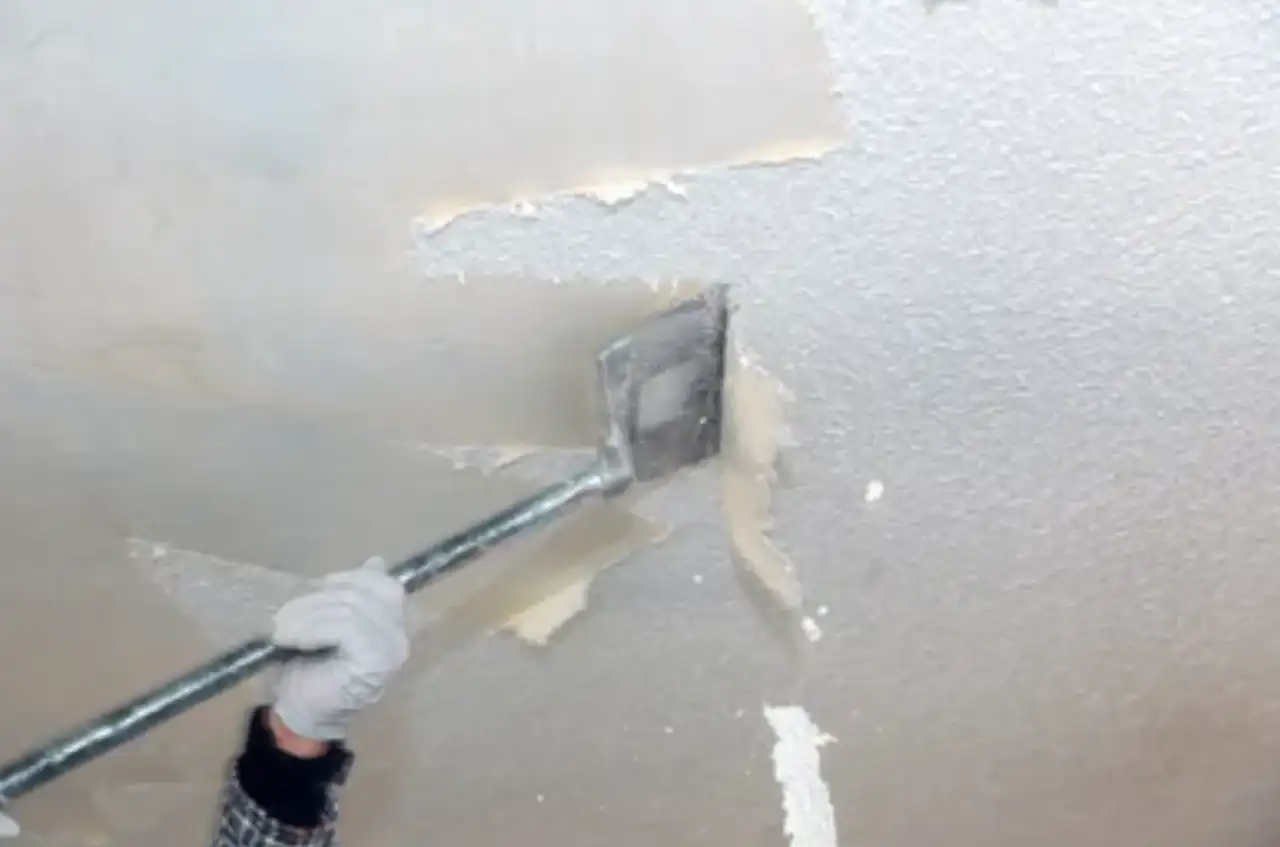
Signs you need this
- • A bumpy, spray-applied ceiling texture that yellows over time, traps dust in every crevice, and makes the room feel dated
- • Chunks of texture flaking or crumbling near a vent, a light fixture, or a spot that got wet at some point
- • An otherwise updated home, new floors, new paint, new fixtures, except for one ceiling that still looks like it belongs to a different decade
This comes up most often for owners of mid-century ranch and colonial homes in Holden, Auburn, Shrewsbury, and Grafton, where acoustic spray ceilings were standard through the 1960s and 70s. It’s just as common a request from homeowners mid-renovation who want a smooth or lightly textured modern ceiling instead of the original spray texture, sellers prepping a Worcester-area home for market who’ve been told a popcorn ceiling reads as dated to buyers, and anyone who bought an older home and inherited a textured ceiling they never chose.
Worcester Drywall & Plaster removes sprayed acoustic and textured ceiling finishes and refinishes the ceiling smooth or with a lighter contemporary texture. Before any scraping starts on a ceiling old enough to be a candidate, the material gets tested for asbestos content, since acoustic texture products manufactured before the early 1980s commonly contained it. Once a ceiling is cleared, or handled by a licensed abatement contractor if it is not, the crew scrapes back to bare board or plaster, repairs the surface underneath, and finishes it to a smooth Level 4 or Level 5 depending on the room’s lighting and use.
Removing a Dated Ceiling the Right Way
A popcorn ceiling is the one piece of an otherwise updated Worcester home that gives its age away. New paint, new floors, new trim, and then a bumpy, light-catching ceiling texture that has not been touched since it was sprayed on. Worcester Drywall & Plaster treats removing it as two jobs stacked together: confirming what the material actually is, and then doing the scrape and refinish cleanly once that question is settled.
Testing Comes Before Scraping, Not After
The single most important step on this job happens before a scraper ever touches the ceiling. Acoustic spray texture products manufactured before the early 1980s commonly contained asbestos, and disturbing that material without testing first is a real health risk, not a theoretical one. Worcester Drywall & Plaster looks at the home’s construction date and renovation history and, for anything in that window, arranges testing through a certified lab before scheduling removal. If a sample comes back positive, the job routes to a licensed asbestos abatement contractor under Massachusetts Department of Labor Standards requirements, and Worcester Drywall & Plaster picks up the drywall and finish work once the room is cleared. This sequencing is not a formality. It is the difference between a safe renovation and a homeowner unknowingly spreading asbestos fibers through their own ductwork with a hand scraper.
Why This Texture Shows Up So Often in the Suburban Ring
Popcorn ceilings are a strong marker of one particular building era, and that era is well represented in the towns ringing Worcester. Holden, Auburn, Shrewsbury, and Grafton all saw heavy ranch and colonial construction through the 1960s and 70s, and acoustic spray texture was a standard, low-cost ceiling finish during exactly that period, prized at the time for hiding minor ceiling imperfections and dampening sound. Decades later, that same texture reads as dated rather than practical, which is why so many of these removal calls come from that suburban ring rather than from Worcester’s older three-decker and Victorian stock, where lath-and-plaster ceilings were the norm instead.
Scrape, Skim, or Re-Texture: Choosing the Right Path
Once a ceiling is cleared for removal, there is more than one way to finish it, and the right choice depends on the ceiling’s condition and the room’s use. A wet-scrape, where the texture is lightly misted before removal, keeps dust down and is the standard approach for board that is in reasonably good shape underneath. Some ceilings, especially older plaster ones, scrape poorly and risk gouging the substrate; in those cases Worcester Drywall & Plaster sometimes recommends skimming a layer of joint compound directly over a tested, well-adhered texture instead of fighting it off entirely. After the surface is bare or skimmed, the homeowner picks the finish: a fully smooth Level 5 skim coat for a modern flat ceiling, or a lighter contemporary texture like a knockdown if a fully flat finish is not the goal. Level 5 takes more coats, more sanding, and more time to get right, especially under a room with strong window light or track lighting that would otherwise expose every flaw, but it is the finish most homeowners picture when they say they want the popcorn gone for good.
What’s Actually Under the Texture
Scraping off decades-old texture almost always uncovers something: hairline cracks from settling, a water stain from a long-forgotten leak, or fastener pops where the board was never quite secured to the joist. Worcester Drywall & Plaster treats the scrape as an inspection as much as a removal, repairing anything found underneath before the new finish goes on. Skipping that step and skimming straight over a hidden problem just buries it under fresh joint compound, and it reappears as a crack or stain within a year or two. The goal is a ceiling that looks intentional and holds up, not one that just looks better for a season.
Containing the Mess
Even a clean, tested removal job generates a lot of fine dust. Worcester Drywall & Plaster seals the work area with plastic sheeting floor to ceiling, protects flooring and furniture, and uses wet-scrape technique specifically to cut down what becomes airborne. For occupied homes, this containment matters as much as the finish work itself, since the goal is a smooth new ceiling without a fine white film settling over the rest of the house for weeks afterward.
Related Work
Popcorn ceiling removal often starts with asbestos testing through a licensed lab, coordinated by Worcester Drywall & Plaster, and licensed abatement if a sample comes back positive. Once the ceiling is scraped and refinished, interior painting finishes the newly smooth or re-textured surface. This work is often combined with skim coat and Level 5 finish work when a homeowner wants the whole room, not just the ceiling, brought to a modern smooth finish.
Materials & standards
Products & materials we use
- USG Sheetrock
- National Gypsum Gold Bond
- Georgia-Pacific ToughRock
- CertainTeed
- DensGlass
Standards & codes we work to
- 780 CMR (Massachusetts State Building Code)
- GA-214 finish Levels 0-5
- EPA RRP lead-safe work practices for pre-1978 homes
- Massachusetts Department of Labor Standards asbestos program (for the abatement handoff)
- Massachusetts Construction Supervisor License (CSL)
- Massachusetts Home Improvement Contractor (HIC) registration
- EPA RRP Lead-Safe Certified Firm
What the terms mean
- Popcorn ceiling
- Acoustic spray texture
- Wet-scrape removal
- Skim coat
- Level 4 and Level 5 finish
- Knockdown texture
- Orange peel texture
- Dust containment
- Asbestos-age testing
Options & variants
| Option | When it applies | Cost |
|---|---|---|
| Test only | Homeowner wants asbestos results before deciding on removal timing or budget | Low cost, standalone service |
| Scrape and skim to smooth finish | Ceiling tests clear, homeowner wants a flat modern look | Moderate to higher cost depending on ceiling condition |
| Scrape and re-texture (knockdown or orange peel) | Homeowner wants a contemporary texture rather than fully flat | Moderate cost, less finishing labor than a full skim |
| Skim-over without scraping | Texture is sound and tests clear but scraping risks damaging old plaster underneath | Alternative to scraping, similar labor to a light skim |
| Abatement-coordinated removal | Ceiling tests positive for asbestos | Higher cost, includes licensed abatement before drywall work begins |
What affects cost
- • Whether the ceiling needs asbestos testing at all, based on the home's age and any prior renovation history
- • Square footage and ceiling height, since a stairwell or vaulted ceiling takes longer and needs more setup than a flat bedroom ceiling
- • Whether the surface underneath is plaster or drywall, since plaster scrapes differently and is more prone to damage during removal
- • The finish level requested afterward. A fully smooth Level 5 ceiling takes more coats and more sanding than a re-textured knockdown finish
- • Number of light fixtures, vents, and sprinkler heads that need to be removed and reset around the work area
- • Whether the room needs to stay in use during the project, which affects dust containment and scheduling
What to expect
- 1
Inspect and test for asbestos
Worcester Drywall & Plaster inspects the ceiling and, if the home's age puts it in the pre-1980s window, arranges asbestos testing before touching the texture.
- 2
Seal the room and set up for wet-scrape
Once results come back clear, the room gets sealed off with plastic sheeting and floor protection, and the crew sets up for wet-scrape removal to keep dust down.
- 3
Scrape and repair the surface
The texture is scraped back to bare board or plaster, and any gouges, water stains, or damaged joints uncovered underneath get repaired.
- 4
Refinish to the target look
The ceiling is refinished to the agreed target, either a smooth Level 4 or 5 skim or a lighter contemporary texture matched to the homeowner's preference.
- 5
Clean up and final walkthrough
The crew cleans the room, resets light fixtures and vents, and walks the ceiling with the homeowner under the room's actual lighting before calling the job done.
When this isn’t the right call
- If asbestos testing comes back positive, that becomes a licensed abatement job first; Worcester Drywall & Plaster coordinates the drywall and finish work after abatement clears the space.
- If the goal is a specific sprayed or hand-applied texture rather than removal, that is a texture matching job, not a removal.
- If the ceiling is structurally sagging or water-damaged rather than just texturally dated, that points to water damage drywall repair first.
- If the entire room is original lath-and-plaster and the texture is a plaster finish rather than a sprayed acoustic coating, that is a plaster conversation, closer to plaster repair and conversion.
Frequently asked questions
How do I know if my popcorn ceiling has asbestos? +
Age is the first clue. Homes built or last renovated before the early 1980s are candidates, since acoustic spray texture products commonly contained asbestos until then. Worcester Drywall & Plaster arranges testing through a certified lab before any scraping starts on a ceiling in that window; a visual guess is never enough.
What happens if the test comes back positive? +
The ceiling gets handled by a licensed asbestos abatement contractor under Massachusetts Department of Labor Standards requirements before any drywall work happens. Worcester Drywall & Plaster coordinates the sequencing so the drywall and finish work picks up cleanly once abatement clears the room.
Can you just skim over the popcorn texture instead of scraping it off? +
Sometimes. If the texture tests clear and is well adhered, skimming a layer of joint compound over it can be faster and less messy than scraping, especially over older plaster that scrapes poorly. Worcester Drywall & Plaster makes that call after inspecting the ceiling in person.
Will the ceiling be perfectly smooth afterward or will I still see texture? +
That depends on what's chosen. A Level 5 skim finish is fully smooth under any lighting, including raking light from a window or recessed fixture. A re-textured knockdown or orange peel finish is contemporary but not flat. Worcester Drywall & Plaster explains the trade-offs for the room's lighting before starting.
How messy is this project? +
Scraping texture is a dusty process. Worcester Drywall & Plaster seals the room with plastic sheeting, protects floors and fixtures, and uses wet-scrape methods to cut down airborne dust, but plan on the room being out of use for the duration of the work.
My ceiling has some water staining under the texture. Does that change anything? +
Yes. Any staining or soft spots found once the texture is scraped off get addressed as part of the same job rather than covered over, since finishing over damaged board just brings the problem back later.
Is popcorn ceiling removal common in older Worcester homes or newer ones? +
Mostly older. Acoustic spray ceilings show up most often in mid-century ranch and colonial homes across Holden, Auburn, Shrewsbury, and Grafton built or finished in the 1960s and 70s, which is exactly the era the asbestos testing question applies to.