
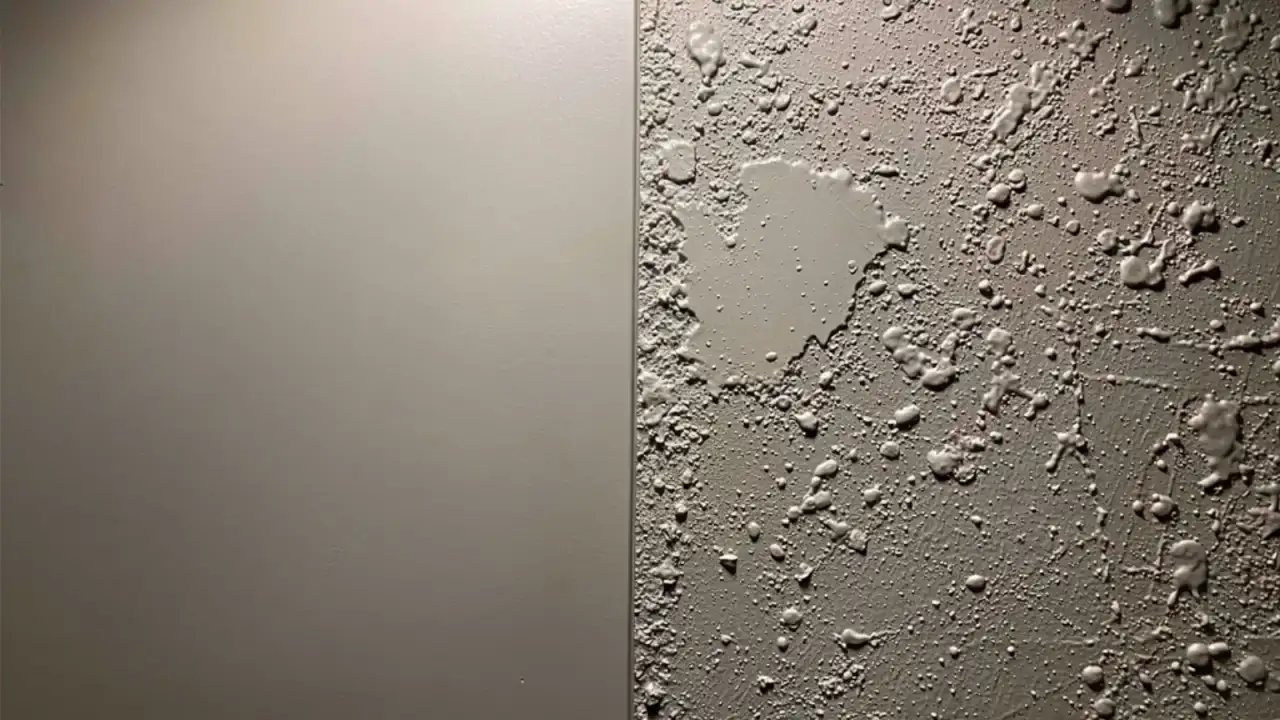
Signs you need this
- • A repaired spot on a wall or ceiling that is perfectly smooth while everything around it has a knockdown, orange peel, or hand-applied texture, so the patch stands out like a flat scar
- • A previous contractor's patch job that is visible from across the room, especially when the light hits it at an angle
- • A section of ceiling or wall repaired after a leak, a hole, or an electrical fix that never got textured to match, leaving a flat rectangle in an otherwise textured surface
This comes up most often for homeowners in the suburban ring, Holden, Shrewsbury, Auburn, and Grafton, where mid-century and newer homes commonly have sprayed knockdown or orange peel ceiling and wall textures. It’s just as common from anyone with a recent drywall repair, electrical fix, or plumbing access patch that was never textured and now reads as an obvious flat spot, homeowners unhappy with a previous contractor’s patch that doesn’t blend in, and sellers preparing a home for market who need visible repairs blended before listing photos or a walkthrough.
Worcester Drywall & Plaster blends a repaired or new section of drywall into the surrounding texture so the patch is not visible once painted. This means identifying the existing texture pattern, knockdown, orange peel, skip-trowel, or a hand-applied finish, then reproducing it with matching tools and technique on the new section, feathering the edges so there is no visible line between old and new. The skill is not in patching the hole. It is in making the transition between old and new surface disappear.
Making the Patch Disappear
Anyone can cut out a section of damaged drywall and screw in a new piece. The part that separates a good repair from an obvious one is what happens after the patch is smooth and dry: matching the texture around it closely enough that nobody looking at the wall or ceiling can tell where the repair starts and stops. Worcester Drywall & Plaster treats texture matching as its own skill, not an afterthought tacked onto a patch job, because a technically sound repair that reads as a flat scar on a textured wall still looks like a failure to the homeowner living with it.
The Blend Is Harder Than the Patch
Cutting and hanging a patch of drywall is a mechanical task with a right answer: level, secured, taped, sanded. Texture matching does not have that same certainty. Every sprayed or hand-applied texture varies slightly from house to house, sometimes from room to room, based on the equipment used, the compound consistency at the time, and even the age of the surrounding surface. A knockdown pattern sprayed twenty years ago has a different density and flattening than one sprayed last year with modern equipment. Worcester Drywall & Plaster starts every texture match by studying the existing pattern up close rather than assuming a standard setting will work, because assuming is exactly how a patch ends up visible.
Test-Board Matching Before Touching the Wall
For anything beyond the simplest, most uniform texture, the crew samples the pattern on a test board, or a hidden section like inside a closet, before ever touching the actual repair area. This step exists because texture spraying involves variables, hopper setting, air pressure, compound thickness, distance from the surface, that all shift the result, and there is no substitute for seeing the test pattern next to the real wall under the same light the room actually gets. Skipping this step and going straight to the patch is how a contractor ends up redoing a texture match two or three times, each attempt visible in a slightly different way until the whole area gets sanded back and started over.
Knockdown, Orange Peel, and Hand-Applied: Different Techniques for Different Textures
The suburban ring around Worcester, Holden, Shrewsbury, Auburn, and Grafton, is where sprayed textures show up most consistently, largely because these towns saw heavy mid-century and later construction when sprayed ceiling and wall textures were standard rather than the exception. Knockdown texture starts as a stippled spray pattern that gets lightly flattened with a trowel a few minutes after spraying, producing a mottled, low-relief look. Orange peel is left exactly as sprayed, a finer and more uniform bumpy texture. Both require dialing in a spray hopper to the right settings, which only comes from comparing against the existing wall in real time. Skip-trowel and other hand-applied textures skip the sprayer entirely, built up with a trowel worked by feel, and take longer to match since there is no equipment setting to replicate, only technique.
Feathering the Transition
The actual secret to an invisible patch is not the texture pattern itself, it is how far past the repair edge the texture gets feathered. A patch textured only within the boundaries of the repaired drywall almost always shows a faint ring where the new texture meets the old, even with a good pattern match, because the transition zone itself has no gradual blend. Worcester Drywall & Plaster deliberately extends the texture work several inches beyond the patch edge into the surrounding original surface, tapering the density so there is no single line where anyone’s eye can catch a difference. This is the step most rushed jobs skip, and it is usually the reason a previous contractor’s patch is still visible when a homeowner finally calls for a real fix.
Checking Under Real Light, Not Just Up Close
A texture match can look convincing from two feet away under a work light and still show up under the room’s actual lighting once paint goes on. Angled light from a window or a ceiling fixture exaggerates any texture inconsistency far more than flat, even light does. Worcester Drywall & Plaster reviews every completed texture match from across the room and at an angle, not just up close, and touches up before paint rather than after, since fixing a texture mismatch after painting means repainting the whole wall or ceiling to avoid a visible patch of new paint on top of it.
Related Work
Texture matching follows the underlying drywall repair, patch, or new installation that created the section needing texture. Interior painting finishes the blended area once the texture matches and has cured. This work is often combined with general drywall repair, water damage repair, or any patch job where the homeowner wants the repair invisible, not just structurally sound.
Materials & standards
Products & materials we use
- USG Sheetrock
- National Gypsum Gold Bond
- CertainTeed
- Georgia-Pacific ToughRock
- FibaTape
Standards & codes we work to
- GA-214 (Gypsum Association finish Levels 0-5)
- 780 CMR (Massachusetts State Building Code)
- Massachusetts Construction Supervisor License (CSL)
- Massachusetts Home Improvement Contractor (HIC) registration
- Manufacturer installer programs
What the terms mean
- Knockdown texture
- Orange peel texture
- Skip-trowel
- Hand-applied texture
- Feathering
- Test-board matching
- Joint compound
- Mud and tape
- Spray hopper
Options & variants
| Option | When it applies | Cost |
|---|---|---|
| Spray knockdown match | Existing texture is a sprayed knockdown finish, common in newer suburban homes | Moderate cost, requires spray equipment and test-board matching |
| Orange peel match | Existing texture is a finer, spray-applied orange peel finish | Moderate cost, similar process to knockdown |
| Skip-trowel or hand-applied match | Existing texture was applied by hand rather than sprayed | Higher cost, more time-intensive to replicate by hand |
| Small-patch blend | A single small repair area needs texture to match surrounding wall or ceiling | Lower cost, priced with the underlying patch job |
| Large-section or whole-room match | A large repaired area, or texturing a new addition to match an existing room | Higher cost based on square footage and texture complexity |
What affects cost
- • Type of texture being matched. Sprayed textures like knockdown and orange peel require the right spray equipment and hopper; hand-applied textures like skip-trowel take more time to replicate by hand
- • Size of the area needing texture, since spray equipment has a minimum practical setup cost even for a small patch
- • How distinct or unusual the existing texture is. A generic light knockdown is easier to match than a heavier, irregular hand-applied pattern
- • Whether test-board sampling is needed first to dial in the right texture density and pattern before touching the actual wall
- • Lighting in the room, since texture mismatches show up more under strong or angled light, which can call for extra blending passes
- • Whether the patch itself still needs to be done, or texture matching is the only remaining step on an existing repair
What to expect
- 1
Examine the existing texture
Worcester Drywall & Plaster examines the existing texture up close, identifying whether it is sprayed knockdown, orange peel, skip-trowel, or another hand-applied pattern.
- 2
Test-board the match
For anything beyond a simple, uniform pattern, a small test board or hidden section of wall gets sampled first to dial in the right compound consistency, spray pattern, or trowel technique.
- 3
Prep and prime the patch
The repaired or new drywall section is prepped and primed so it accepts texture the same way the surrounding surface does.
- 4
Apply and feather the texture
Texture is applied to the patch area, feathering the edges well beyond the repair itself so there is no hard line where old and new textures meet.
- 5
Review under real lighting
The area is reviewed under the room's actual lighting, including from an angle, and touched up before paint goes on.
When this isn’t the right call
- If the homeowner actually wants the texture gone entirely rather than matched, that's popcorn ceiling removal or a full skim coat and Level 5 finish, not a texture match.
- If the underlying repair itself has not been done yet, such as an active leak or a hole from damage, that needs drywall repair or water damage drywall repair first, with texture matching as the final step.
- If the whole room's texture is failing or outdated and the goal is a broader refinish rather than blending one patch, that is a larger resurfacing conversation, not a single texture match.
- If the surface is original lath-and-plaster texture rather than a sprayed drywall finish, that calls for plaster repair and conversion expertise instead.
Frequently asked questions
Can you really make a patch invisible, or will I always be able to tell? +
A well-matched texture patch, properly feathered and painted, should not be visible under normal room lighting. Worcester Drywall & Plaster tests the texture pattern on a sample area first specifically to avoid the guesswork that leads to a visible seam.
My last contractor's patch is smooth but the rest of my ceiling is textured. Can you fix that after the fact? +
Yes, this is one of the most common calls. Applying texture over an existing smooth patch is straightforward as long as the patch itself is sound; Worcester Drywall & Plaster matches the surrounding pattern and feathers it into the existing texture so the flat spot disappears.
What's the difference between knockdown and orange peel texture? +
Both are sprayed textures, but knockdown starts as a stippled spray pattern that gets lightly flattened with a trowel, leaving a mottled, flattened look. Orange peel is left as-sprayed, with a finer, uniform bumpy texture resembling citrus peel. They require different spray settings and technique to reproduce accurately.
Do you need to see the wall in person before quoting texture matching? +
Yes. Texture varies enough from house to house, and sometimes room to room in the same house, that Worcester Drywall & Plaster needs to see and often sample the actual surface before quoting the work or committing to a technique.
How do you match a texture that was applied by hand rather than sprayed? +
Hand-applied textures like skip-trowel take more time since there's no spray pattern to dial in, just trowel technique to replicate by feel. Worcester Drywall & Plaster practices the pattern on a test area first and compares it against the existing wall under the same lighting before touching the actual patch.
Will the texture match perfectly right after painting, or does it need to cure first? +
The texture itself should look right as soon as it's applied and dry, but paint sheen can slightly change how flat versus textured areas catch light. Worcester Drywall & Plaster checks the blend again after primer and after paint, not just after the texture step, to catch anything that shifts once color and sheen are added.
Is texture matching only for ceilings, or does it apply to walls too? +
Both. Textured ceilings are more common in Worcester's suburban ring, but plenty of homes also have textured walls, especially in basements, hallways, and homes built or renovated through the 1970s and 80s.