
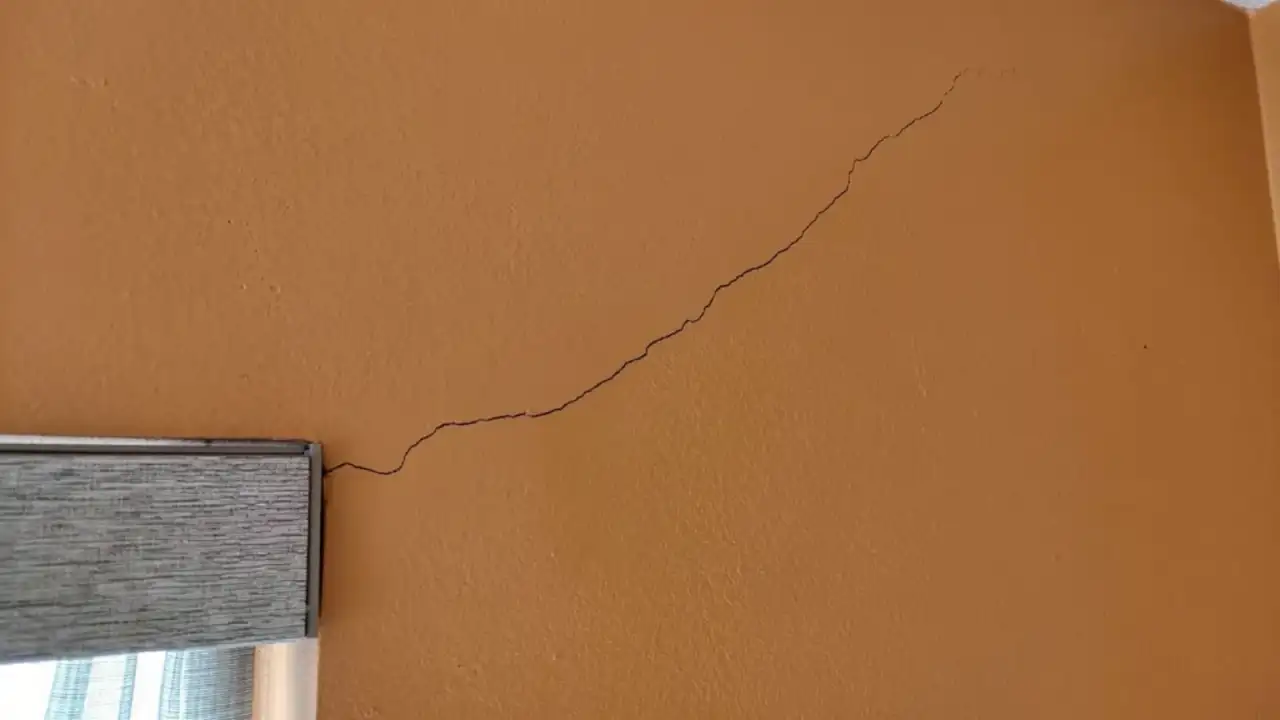
Signs you need this
- • A thin crack running diagonally from the top corner of a door or window frame
- • A crack along an outside corner where the corner bead meets the wall, sometimes with the bead itself visible or lifting
- • A crack that was patched before, maybe more than once, and has reopened in the same spot
- • Cracks that seem to widen in winter and close up slightly by summer
Worcester Drywall & Plaster treats a recurring crack as a diagnosis problem rather than another round of cosmetic patching. A settling or seasonal crack is rarely a structural emergency, but a crack that keeps returning is a signal that the underlying movement was never addressed, and each cycle of drywall paper tearing further from repeated flexing makes the eventual repair larger.
This comes up most for owners of older Victorian homes in Worcester’s West Side and Elm Park-adjacent streets, where a century of foundation settling shows up as recurring drywall and plaster cracks, for anyone who has already had a crack painted over or re-taped once or twice and watched it reopen within a season, for homeowners noticing cracks specifically near door and window corners, a classic stress-crack pattern, and for three-decker owners dealing with cracks that track the building’s seasonal wood movement across multiple units.
Worcester Drywall & Plaster repairs cracks in a way built to actually hold, not just to look good until the next heating season. That starts with reading why the crack formed: a stress crack radiating from a door or window corner behaves differently than a crack along a corner bead, which behaves differently than a wide seasonal crack from truss movement. Depending on the cause, the fix might use mesh tape, paper tape, a flexible movement joint, or a fully re-set corner bead, chosen specifically so the repair can tolerate the amount and direction of movement causing the crack in the first place. A crack repaired the wrong way is a repair that comes back; Worcester Drywall & Plaster’s approach is built around matching the fix to the cause so it doesn’t.
Why Cracks Keep Coming Back in Worcester Homes
A crack that reappears after being patched is not bad luck, it’s a diagnosis problem. Somewhere between the first repair and the second, the crack’s actual cause was never addressed, only its surface. Worcester’s building stock gives this pattern a lot of room to play out: Victorian-era homes on the West Side and around the city’s older districts have had well over a century to settle, framing has dried and shifted, and every heating season adds another small cycle of expansion and contraction. A crack repair that doesn’t account for ongoing movement is, by design, temporary.
Stress Cracks Versus Settlement Cracks
Not all cracks share a cause, and treating them the same way is the most common reason a repair fails. A stress crack radiating diagonally from the top corner of a door or window frame is typically a load pattern built into framed openings: the corner concentrates stress every time the house flexes even slightly, and a straight diagonal crack forms along the shortest path between the frame corner and the nearest wall edge. This is common and rarely a sign of anything structurally wrong, but it does need reinforcement that can flex with the opening rather than a rigid patch. A settlement crack, by contrast, tends to run wider and more irregularly, often where two different parts of a structure (an addition and the original house, for instance) settle at slightly different rates.
The Seasonal Crack: Truss Uplift
New England’s heating season introduces a crack pattern that surprises a lot of homeowners: a crack that widens every winter and seems to partially close by summer, often running along a ceiling-wall joint or straight across a ceiling. This is frequently truss uplift, where the top and bottom chords of a roof truss dry out and shrink at different rates during the winter heating months, lifting the truss’s center slightly and flexing the ceiling below it. A standard rigid re-tape across a truss uplift crack will reopen almost every winter, because the tape has no way to accommodate the truss’s actual movement. The fix in this case is a movement joint, sometimes called a control joint: a deliberate flexible gap, taped and finished in a way that allows a small amount of motion without transferring stress into the surrounding drywall.
Mesh Tape, Paper Tape, and Why the Choice Matters
Two tape systems are commonly used to bridge a crack before compound goes over it, and the choice between them is not just a matter of preference. Self-adhesive mesh tape is fast to apply and grips well to the wall on its own, which makes it popular for quick cosmetic patches, but it is more rigid once embedded in compound and doesn’t tolerate repeated flexing as well. Paper tape, folded into a corner and bedded in wet compound, has a small amount of give and has historically performed better on cracks subject to ongoing seasonal movement. Worcester Drywall & Plaster frequently sees homes where a previous contractor or DIY repair used mesh tape on a crack that turned out to be seasonal, and converting that repair to paper tape, or to a proper movement joint where the movement is significant, is what finally makes it hold.
Corner Bead Cracks Are a Different Animal Entirely
A crack that runs specifically along an outside corner, where two walls meet at a protruding edge, usually points to the corner bead itself rather than a settling or seasonal issue. Corner bead is a strip of metal or vinyl embedded in compound to create a crisp, durable corner edge, and it can crack loose from an impact, from compound applied too thin over it originally, or simply from age. No amount of re-taping the visible crack line fixes this if the bead underneath has separated from the wall; the bead has to be reset or replaced, refastened tight to the framing, and then finished properly for the crack to actually stop recurring.
When to Stop Chasing Individual Cracks
In some of Worcester’s older homes, particularly those with original lath and plaster still intact, cracking can be widespread rather than isolated to one or two spots. When that’s the pattern, repeatedly patching each crack as it appears becomes a losing game against a house that is settling and moving as a whole system. Worcester Drywall & Plaster will say so directly when a homeowner’s cracking has reached that point, rather than billing for another round of spot repairs that are likely to reopen within a year or two.
Related Work
Noting when a crack appears or reappears, which season, after what, helps Worcester Drywall & Plaster diagnose it faster, though nothing needs to happen before the repair itself. Repainting the wall or ceiling section follows once the repair is done. Broader wall or ceiling patching often gets combined in if cracks show up alongside holes or dents, and a plaster-to-drywall conversion sometimes follows if cracking turns out to be building-wide in an older home.
Materials & standards
Products & materials we use
- USG Sheetrock
- National Gypsum Gold Bond
- FibaTape
- CertainTeed
Standards & codes we work to
- 780 CMR (Massachusetts State Building Code)
- ASTM C1396
- GA-214 finish levels
- Massachusetts Construction Supervisor License (CSL)
- Massachusetts Home Improvement Contractor (HIC) registration
What the terms mean
- Corner bead
- Mesh tape
- Paper tape
- Mud and tape
- Movement joint
- Truss uplift
- Settling crack
- Stress crack
- Joint compound
Options & variants
| Option | When it applies | Cost |
|---|---|---|
| Cosmetic re-tape | A single, non-recurring hairline crack with no ongoing movement | Lowest cost, fastest |
| Mesh-to-paper tape conversion | A crack that reopened after a mesh tape repair, since mesh flexes less predictably under movement | Mid-range, requires removing old tape |
| Corner bead reset or replacement | Cracking specifically along an outside corner | Mid-range, adds bead material |
| Movement (control) joint installation | Recurring seasonal cracks tied to truss uplift or known structural movement | Higher cost, addresses the root cause rather than just the surface |
What affects cost
- • Whether the crack is a one-time settlement crack or a recurring seasonal crack that needs a movement joint rather than a simple re-tape
- • Length and location of the crack, and whether it's isolated or part of a pattern across several walls or ceilings
- • Whether a previous repair has to be removed first, since old mesh tape or compound often has to come out before a lasting fix goes in
- • Access to the affected wall or ceiling section
- • Whether corner bead needs to be reset or replaced as part of the repair
What to expect
- 1
Diagnose the cause
Worcester Drywall & Plaster examines the crack's shape, location, and history (has it been patched before, does it change with the seasons) to identify the actual cause.
- 2
Remove prior repair material
Any prior repair material is removed if it's contributing to the crack reopening.
- 3
Choose the right reinforcement
The right reinforcement is chosen for the cause, paper tape, mesh tape, a movement joint, or fresh corner bead.
- 4
Apply and feather compound
Compound is applied in coats, feathered wide, and sanded smooth between coats.
- 5
Match texture and prime
Texture is matched to the surrounding wall or ceiling and the area is primed.
- 6
Explain the cause and outlook
Worcester Drywall & Plaster explains what caused the crack and what, if anything, the customer can expect to watch for going forward.
When this isn’t the right call
- If the wall has a hole or dent rather than a crack, a better fit is drywall repair and patching.
- If the crack is accompanied by sagging or the ceiling has dropped material, a better fit is ceiling repair.
- If the crack came with a water stain or followed a leak, a better fit is water damage drywall repair.
- If cracks are widespread across original lath and plaster and a full conversion makes more sense than repeated spot repairs, a better fit is plaster repair and conversion.
Frequently asked questions
Why does this crack keep coming back after I've had it patched before? +
Usually because the previous repair addressed the crack's appearance, not the movement causing it. Worcester Drywall & Plaster looks at whether the crack is seasonal, tied to a specific corner, or linked to structural settling, then chooses tape and technique built to move with the house rather than fight it.
Are cracks near my doors and windows a sign of a foundation problem? +
Not necessarily. Diagonal cracks from door and window corners are a very common stress pattern in framed openings and often reflect normal, ongoing settling rather than a structural issue. Worcester Drywall & Plaster can tell you if what's seen points to something more serious.
What's the difference between mesh tape and paper tape for a crack repair? +
Mesh tape is faster to apply but more rigid, so it can crack again under repeated movement. Paper tape, embedded in compound, flexes slightly more and holds up better on a crack that's likely to see seasonal movement, which is why Worcester Drywall & Plaster often converts a recurring mesh-taped crack to paper tape.
My house is old and has cracks in a lot of rooms. Do you fix them one at a time? +
It depends on the pattern. A few isolated cracks are handled individually, but if cracking is widespread across an older home's plaster, Worcester Drywall & Plaster may recommend a broader look rather than chasing the same settling crack room by room.
Will the crack ever come back after your repair? +
A properly diagnosed and repaired crack, matched to its actual cause, should hold. Worcester Drywall & Plaster won't guarantee a house will stop settling entirely, but the goal is a repair that moves with that settling instead of cracking again in the same spot.
Does cold weather actually make cracks worse in Worcester? +
Yes, seasonal temperature and humidity swings, along with truss uplift during winter heating season, are a real and common cause of recurring cracks in this area. It's one of the first things Worcester Drywall & Plaster checks for on a crack that reopens each year.