
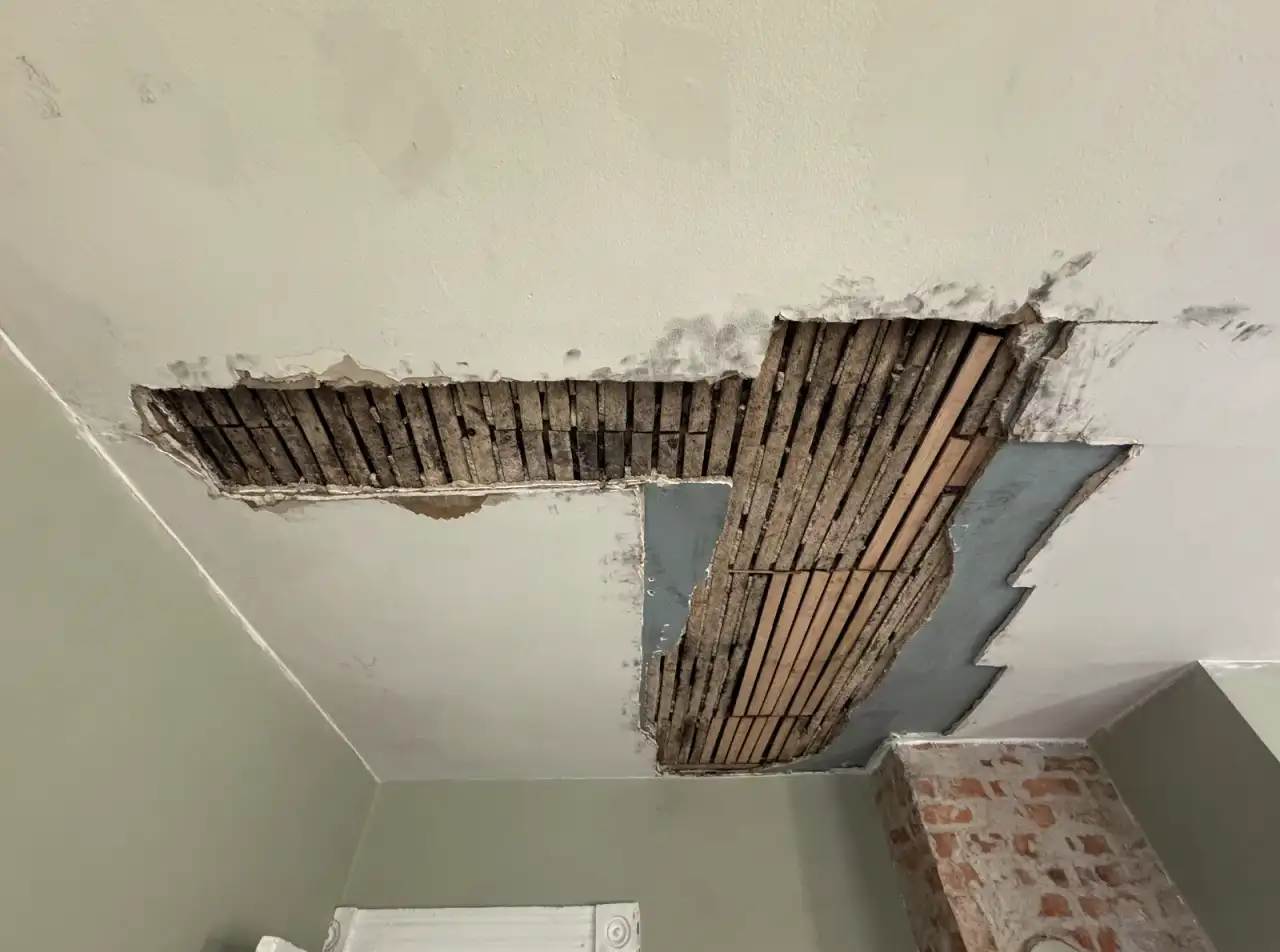
Signs you need this
- • Spidery cracks running across a plaster ceiling or wall, often radiating from a corner or a doorway
- • A section of plaster that feels soft, springy, or hollow when tapped, a sign the plaster has let go of the wood lath behind it
- • Bulging or sagging patches on a ceiling, sometimes with a visible shadow line where the plaster has pulled away
- • Chunks of plaster that have already fallen, exposing wood lath strips and horsehair-reinforced base coat
- • A patchwork of old paint-over repairs that keep re-cracking in the same spots year after year
- • Water staining on plaster near a roof leak, old chimney, or upstairs bathroom, softened plaster that crumbles at a touch
Worcester’s housing stock is older than most of Massachusetts realizes. Elm Park, Crown Hill, Montvale, and the affluent West Side hold a dense concentration of homes built between 1870 and 1925, and the city’s pre-1940 three-decker neighborhoods, Vernon Hill, Grafton Hill, Main South, Green Island, and Union Hill, add thousands more units of original lath-and-plaster construction. That’s the real plaster market in this city, and it’s work most general “sheetrock” crews avoid because it doesn’t behave like modern drywall. Worcester Drywall & Plaster specializes in exactly this kind of old-home plaster work, from targeted crack repair to full plaster-to-drywall conversion.
This work comes up most often for owners of 1870 to 1925 Victorian-era homes in Elm Park, Crown Hill, Montvale, and the West Side, where original lath-and-plaster walls and ceilings are still largely intact, for owners of pre-1940 three-deckers in Vernon Hill, Grafton Hill, Main South, Green Island, and Union Hill dealing with decades of settling cracks and prior patch jobs, for buyers who just closed on an older Worcester home and had an inspector flag failing plaster or exposed lath, for homeowners mid-renovation who need one or two rooms brought back to a smooth, paintable finish without gutting the whole house, and for anyone with a pre-1978 Worcester home who needs plaster work done in a way that follows EPA lead-safe rules, since old paint layers on plaster commonly test positive for lead.
Worcester Drywall & Plaster repairs original lath-and-plaster walls and ceilings in the city’s older housing stock, and where the plaster is too far gone, converts the surface over to modern drywall. Repair work means securing loose plaster back to the wood lath, filling and reinforcing cracks, and skim coating the surface smooth. Conversion means removing failed plaster and lath down to the framing and rebuilding the wall or ceiling with blueboard and veneer plaster or standard drywall, matched to the room’s existing texture and trim. Worcester Drywall & Plaster evaluates each ceiling and wall on its own, room by room, rather than assuming every crack needs a full teardown.
Plaster Repair and Plaster-to-Drywall Conversion in Worcester
Why plaster fails: understanding key loss
Original plaster in a Worcester Victorian or three-decker is a three-coat system troweled over wood lath strips, thin, gapped boards nailed across the studs and joists. Wet plaster was pushed through the gaps between lath strips and squeezed out into little curls on the back side called keys. Those keys are what hold the entire wall or ceiling to the framing. There’s no adhesive, no screws through the plaster itself, just those keys hardened in place.
Over a century of seasonal humidity swings, minor settling, and vibration, those keys break off one by one. This is called key loss, and it’s the real failure mode behind almost every serious plaster problem. A ceiling that feels springy or sags slightly isn’t necessarily cracked on the surface, it’s often held up by fewer and fewer intact keys until gravity wins. Surface cracking is a symptom, not the disease. Worcester Drywall & Plaster taps and presses on suspect areas to find out how much of the plaster’s key is actually still gripping the lath before deciding on a repair approach.
Repair versus full conversion: how the decision gets made
Not every cracked wall needs to come down. When plaster is still well keyed to the lath and the damage is limited to surface crazing or a handful of cracks, repair is the right call. Worcester Drywall & Plaster stabilizes loose sections with plaster washers, thin metal or plastic discs screwed through the plaster into the lath or framing to mechanically re-anchor it, then bridges cracks with fiberglass mesh embedded in setting-type joint compound, commonly called hot mud because it sets chemically rather than by air drying and can be built up in the same visit.
When a ceiling or wall has widespread key loss, when large areas sag, or when the plaster has already partially collapsed, patching becomes a losing game. In those cases, converting the surface to drywall, either blueboard finished with veneer plaster to keep a plaster-like hardness, or standard drywall, gives a more stable and predictable long-term result. The honest answer isn’t always the more expensive one. A ceiling that’s 80 percent solid with a few bad spots gets repaired. A ceiling where tapping produces a hollow drum sound across most of its surface gets converted, because re-securing that much lost key would cost more in labor than tearing it out and starting fresh.
Skim coating and matching a century of texture
Old plaster surfaces have their own character: hand-troweled variation, slight waves, a texture that a machine-applied modern finish doesn’t naturally replicate. When a wall or ceiling needs a full resurface, whether after extensive crack repair or as prep before repainting, Worcester Drywall & Plaster applies a skim coat, a thin finish layer of joint compound or veneer plaster troweled over the entire surface to level it out.
For rooms where matching the exact original hand-troweled texture isn’t practical, taking the surface to a Level 5 finish, the smoothest classification under the GA-214 finish level system, often works better than attempting to fake a texture that won’t quite match. A Level 5 skim, a thin veneer of compound applied over the entire surface and lightly sanded, hides seams and imperfections under raking light from windows, which matters in older homes with large, low-angle window exposures. The honest move is to know when texture matching will actually blend in versus when a clean, uniform Level 5 finish serves the room better, and to say so plainly rather than guessing and hoping.
Lead-safe work on pre-1978 Worcester homes
Nearly every original plaster wall in Worcester’s Victorian districts and three-decker neighborhoods carries multiple layers of old paint, and homes built before 1978 fall under EPA Renovation, Repair, and Painting rules. Cutting, sanding, or demolishing painted plaster in these homes can disturb lead-based paint dust. Worcester Drywall & Plaster is an EPA RRP Lead-Safe Certified Firm and sets up containment, plastic sheeting, controlled work zones, and HEPA-filtered cleanup, before starting demo or heavy sanding on any pre-1978 property. This isn’t optional paperwork, it’s how the work gets done safely in a home where kids or pets are still living upstairs while the crew works below.
Working in occupied old homes
Almost none of this work happens in an empty house. Worcester Drywall & Plaster plans around families living in the home during the project: dust barriers between the work zone and the rest of the house, daily cleanup so a kitchen or bathroom stays usable, and furniture protection in rooms with original crown molding, plaster medallions, or coved ceilings that are worth protecting rather than replacing. In a Victorian district home, that trim and detailing is often part of what the owner is trying to preserve, and craft matters more than speed to homeowners in these neighborhoods. Worcester Drywall & Plaster treats the plaster work and the surrounding historic details as one job, not two.
Related Work
Plaster failure sometimes traces back to a roof or plumbing leak, which needs its own fix before the plaster work begins. Once a wall or ceiling is repaired or converted, interior painting primes and finishes the freshly skim-coated surface. On a plaster-to-drywall conversion that changes wall thickness, trim and molding work often follows to adjust historic-sensitive reveals so the finished look stays consistent.
Materials & standards
Products & materials we use
- USG Sheetrock
- Plaster-Weld bonding agent
- FibaTape
Standards & codes we work to
- 780 CMR
- ASTM C1396
- GA-214 finish levels 0 through 5
- EPA RRP
- ICRA
- MA CSL (Construction Supervisor License)
- MA HIC (Home Improvement Contractor registration)
- EPA RRP Lead-Safe Certified Firm
What the terms mean
- Plaster-to-drywall conversion
- Skim coat
- Level 5 finish
- Lath and plaster
- Key loss
- Plaster washers
- Setting-type joint compound (hot mud)
- Pre-mixed joint compound
- Blueboard
- Veneer plaster
- Mesh reinforcement
- Texture matching
- Type X gypsum board
- Historic-sensitive trim reveals
Options & variants
| Option | When it applies | Cost |
|---|---|---|
| Crack repair with mesh and hot mud | Isolated cracking, plaster still solidly keyed to the lath | Lower cost, per-crack or per-room pricing |
| Plaster washer stabilization | Sections where plaster has lost its key to the lath but the plaster itself is intact | Moderate, labor-driven, price scales with area re-secured |
| Skim coat / Level 5 resurface | Widespread surface crazing, texture mismatch from old patches, or prep before repaint | Moderate to higher, priced per square foot of surface skimmed |
| Full plaster-to-drywall conversion | Lath and plaster too deteriorated to save, or a room being opened up for other renovation work | Highest, priced per job including demo, disposal, and lead-safe prep on pre-1978 homes |
| Ceiling-only conversion with walls left as plaster | Sagging or failed ceiling plaster in a room where the walls are still sound | Priced per job, scoped to the ceiling only |
What affects cost
- • How much of the plaster has lost its key to the lath versus surface cracking only, since key-loss means mechanical fastening, not just a skim
- • Whether the home was built before 1978, which triggers EPA RRP lead-safe containment and cleanup on top of the repair itself
- • Whether the room has ornate trim, plaster medallions, or coved ceilings that need to be protected or worked around
- • How much of the surface needs a full skim coat versus spot repair, since Level 5 skim work is priced by square footage
- • Access and containment needs in an occupied home, including furniture moving, dust barriers, and daily cleanup
- • Whether the existing texture is a hand-troweled finish that needs matching versus a flat surface that can go straight to paint prep
What to expect
- 1
Inspect and tap-test
Worcester Drywall & Plaster inspects the affected walls and ceilings, tapping the surface to map where plaster has lost its key to the lath versus where cracking is cosmetic.
- 2
Explain repair versus conversion
The crew explains, room by room, what can be repaired in place and what genuinely needs conversion to drywall, with reasons tied to what they found behind the surface.
- 3
Set up lead-safe containment
On homes built before 1978, the crew sets up EPA RRP lead-safe containment before any cutting, sanding, or demo begins.
- 4
Repair sections that can be saved
For repairs, loose sections get pulled tight with plaster washers, cracks get bridged with mesh and setting-type compound, and the surface gets skim coated to a smooth, level finish.
- 5
Convert sections beyond saving
For conversions, the failed plaster and lath come out, the framing gets inspected, and new blueboard with veneer plaster or standard drywall goes up and gets finished to match the room.
- 6
Clean up and walk through
The crew cleans the work area daily since most of this work happens in occupied homes, and does a final walkthrough once paint-ready.
When this isn’t the right call
- If a homeowner just wants standard drywall installed in a new addition or already-framed space with no old plaster involved, a better fit is drywall installation.
- If the issue is water damage actively coming from a current leak rather than old, dried-out plaster, a better fit is water damage drywall repair.
- If the concern is a small nail hole or minor ding in already-modern drywall, that's a standard patch job, not a plaster conversion.
Frequently asked questions
How do I know if my plaster needs repair or a full conversion to drywall? +
Worcester Drywall & Plaster taps the surface and checks how well the plaster is still keyed to the wood lath behind it. If the plaster is solid and just cracked on the surface, a skim coat and crack repair usually solves it. If large sections have lost their key and sag or feel spongy, converting that section to drywall is usually the more honest long-term fix.
Will converting to drywall match the texture of my other plaster walls? +
Worcester Drywall & Plaster matches the finish texture as closely as possible, and can skim coat to Level 5 for a texture-free surface if that's what the rest of the room needs. In many older Worcester homes, a smooth Level 5 finish actually blends better with hand-troweled plaster than trying to fake an exact plaster texture.
My house was built in the 1890s. Does that mean lead paint rules apply? +
Yes. Any Worcester home built before 1978 falls under EPA RRP lead-safe rules, and original plaster in a Victorian district home almost always has multiple layers of old paint on it. Worcester Drywall & Plaster is an EPA RRP Lead-Safe Certified Firm and sets up proper containment before disturbing the surface.
Can you fix plaster cracks without ripping out the whole wall? +
In most cases, yes. Worcester Drywall & Plaster secures loose plaster with plaster washers, bridges cracks with fiberglass mesh and setting-type joint compound, and skim coats the surface. Full teardown is reserved for sections where the plaster has genuinely failed, not just cracked.
Do you work in homes while people are still living there? +
Yes, most of this work happens in occupied homes. Worcester Drywall & Plaster sets up dust containment, protects furniture and flooring, and cleans the work area at the end of each day so the rest of the house stays livable.
What causes plaster to crack in old Worcester homes in the first place? +
Normal seasonal wood movement in the framing, decades of minor settling, and the natural aging of the lime and gypsum plaster itself all contribute. Most cracking is cosmetic, but cracks near ceiling edges or that keep reopening in the same spot can be a sign the plaster is starting to lose its grip on the lath.
Is a plaster-to-drywall conversion cheaper than repairing plaster? +
Not necessarily. Small repairs are usually less expensive than a conversion, but plaster in poor condition can require so much stabilization work that converting to drywall becomes the more cost-effective option in the long run, especially in a ceiling with widespread key loss.
Will my crown molding or plaster medallions survive the work? +
Worcester Drywall & Plaster protects and works around existing trim, coved ceilings, and plaster medallions wherever possible, since these details are part of what gives Victorian district homes their character. Where a conversion changes wall thickness slightly, the crew adjusts trim reveals to keep the finished look consistent.